Overview
- The problem
- Financial learning can feel text-heavy, difficult to discuss, and disconnected from affordable guidance.
- My contribution
- I documented competitor research, qualitative interviews, synthesis, information architecture, wireframes, and a mobile interface concept.
- The outcome
- A mobile concept connecting financial articles, video, audio, consultation, and discussion groups.
Problem
The source slides document a comparison of Finansialku and Money Lover, unstructured interviews with several millennials, persona synthesis, and an affinity diagram. Findings include limited discussion support, text-heavy information, and consultation cost. The participant total, recruitment details, and raw transcripts are not recorded here.
 Competitive research approach. Original archive, panel 4; open at full size to inspect.
 Finansialku and Money Lover comparison. Original archive, panel 5; open at full size to inspect.
 Unstructured qualitative interview approach. Original archive, panel 6; open at full size to inspect.
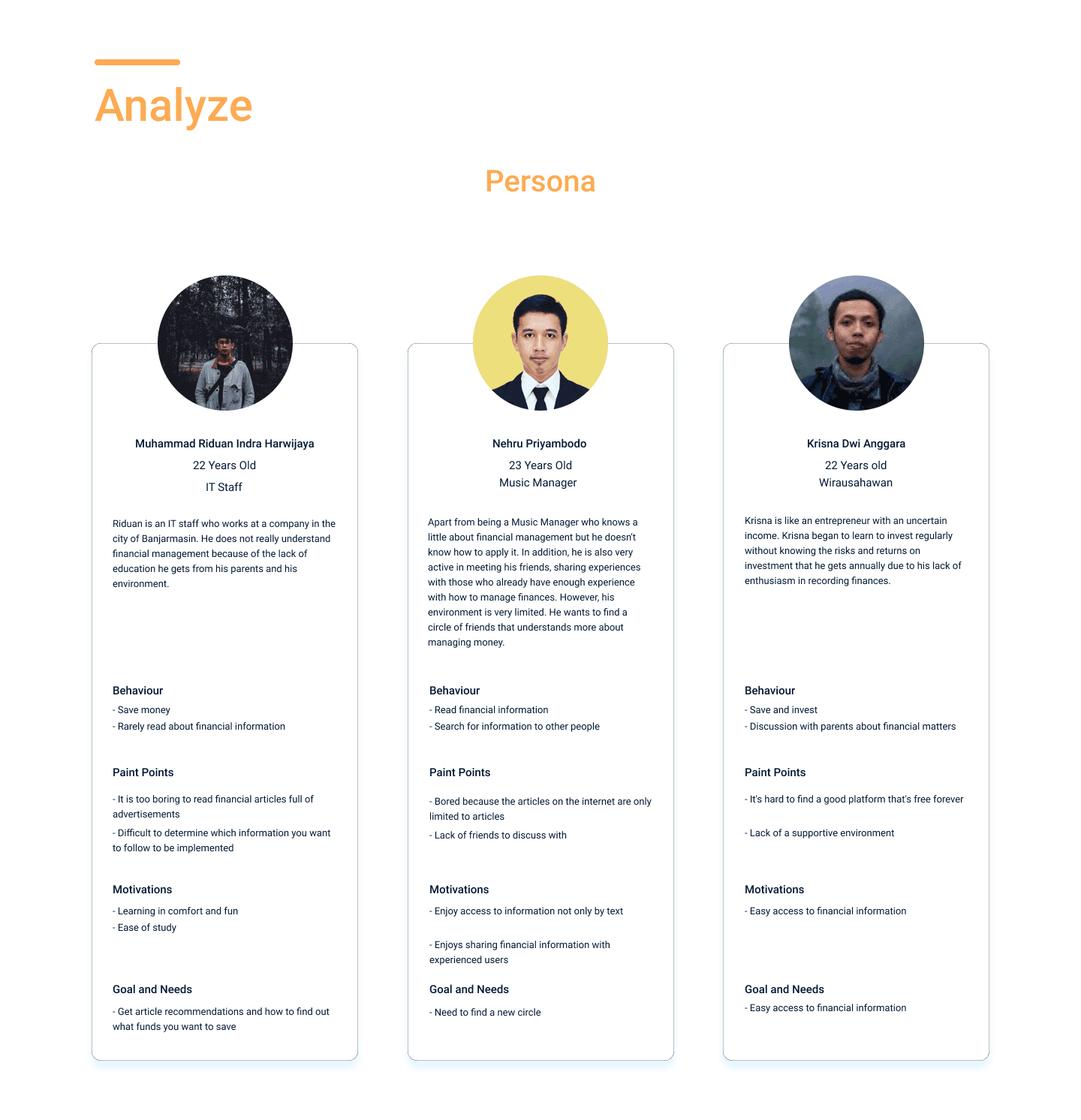 Persona synthesis. Original archive, panel 7; open at full size to inspect.
 Affinity diagram, problem definition, and design mandate. Original archive, panel 8; open at full size to inspect.
My Role
- Company / product context
- Fincy / Finsy · Financial-learning design exploration
- Users
- Millennials preparing for financial responsibilities, described in the archive as potential members of the sandwich generation.
- My role & scope
- I documented competitor research, qualitative interviews, synthesis, information architecture, wireframes, and a mobile interface concept.
- Evidence available
- Original project narrative and design artifacts retained in this case study.
 Product purpose and financial-learning audience. Original archive, panel 2; open at full size to inspect.
Process
The archive progresses from a learning scenario and information architecture to connected low-fidelity mobile wireframes. It shows how content, consultation, discussion, and profile destinations fit together; no tested iteration winner is documented.
 Research-to-design approach. Original archive, panel 3; open at full size to inspect.
 Learning scenario and initial concept sketch. Original archive, panel 9; open at full size to inspect.
 Content, consultation, discussion, and profile information architecture. Original archive, panel 10; open at full size to inspect.
 Connected low-fidelity mobile wireframes. Original archive, panel 11; open at full size to inspect.
Key Decisions
The concept responds to different learning preferences through articles, audio, and video, and adds discussion and consultation. This broad scope creates a content and moderation burden. Those operational requirements are a design implication, not a documented implementation decision.
Final Solution
The high-fidelity concept includes onboarding, multimodal financial content, consultant discovery and chat, and discussion rooms. The original panels below retain the visual and flow evidence.
 High-fidelity mobile design details. Original archive, panel 12; open at full size to inspect.
 Final mobile interface overview. Original archive, panel 13; open at full size to inspect.
Outcomes
The outcome is the research-informed design concept. No release, learning-retention result, consultation uptake, or reduction in financial burden is established by the archive.
Evidence & limitations
The archive uses both Fincy and Finsy naming. It does not establish a commissioned employer engagement, production release, or measured financial outcome.
Interview synthesis does not prove that a broad learning, advice, and community product changes financial behavior.
Learnings
- What worked in the design
- The proposed information architecture offers more than one way to learn and seek support.
- What I would change next
- Narrow the first release to one learning task, test content comprehension and return use, and define the boundaries between education, peer discussion, and professional advice.
 Original project closing. Original archive, panel 14; open at full size to inspect.

