Overview
- The problem
- A limited set of benefit merchants left some people unable to use their allowance for relevant everyday needs.
- My contribution
- I researched allowance needs and designed the proposed GoPay connection, flow, architecture, wireframes, and mobile UI.
- The outcome
- An integration concept covering benefit explanation, account connection, OTP, confirmation, and balance access.
Problem
The slides describe a qualitative survey shared through Fomo to recruit Mekari users. The synthesis records requests for more relevant merchants, transport and shopping options, and GoPay transfers. The participant count and raw responses are not published in the available record.
 Integration exploration objective. Original archive, panel 3; open at full size to inspect.
 Qualitative survey approach and questions. Original archive, panel 5; open at full size to inspect.
 Allowance findings and synthesized opportunities. Original archive, panel 6; open at full size to inspect.
 Problem and user-needs statements. Original archive, panel 7; open at full size to inspect.
My Role
- Company / product context
- Mekari Flex / GoPay · Integration design exploration
- Users
- Mekari Flex users exploring how to spend their available benefits.
- My role & scope
- I researched allowance needs and designed the proposed GoPay connection, flow, architecture, wireframes, and mobile UI.
- Evidence available
- Original project narrative and design artifacts retained in this case study.
 Mekari Flex integration opportunity. Original archive, panel 2; open at full size to inspect.
Process
How-might-we questions lead into account-connection flows, information architecture, and low-fidelity screens. These artifacts show the proposed sequence from benefit explanation through phone confirmation and OTP to a connected account.
 Discover, define, ideate, and design process. Original archive, panel 4; open at full size to inspect.
 How-might-we questions for GoPay connection. Original archive, panel 8; open at full size to inspect.
 Proposed account-connection user flow. Original archive, panel 9; open at full size to inspect.
 Connection and balance information architecture. Original archive, panel 10; open at full size to inspect.
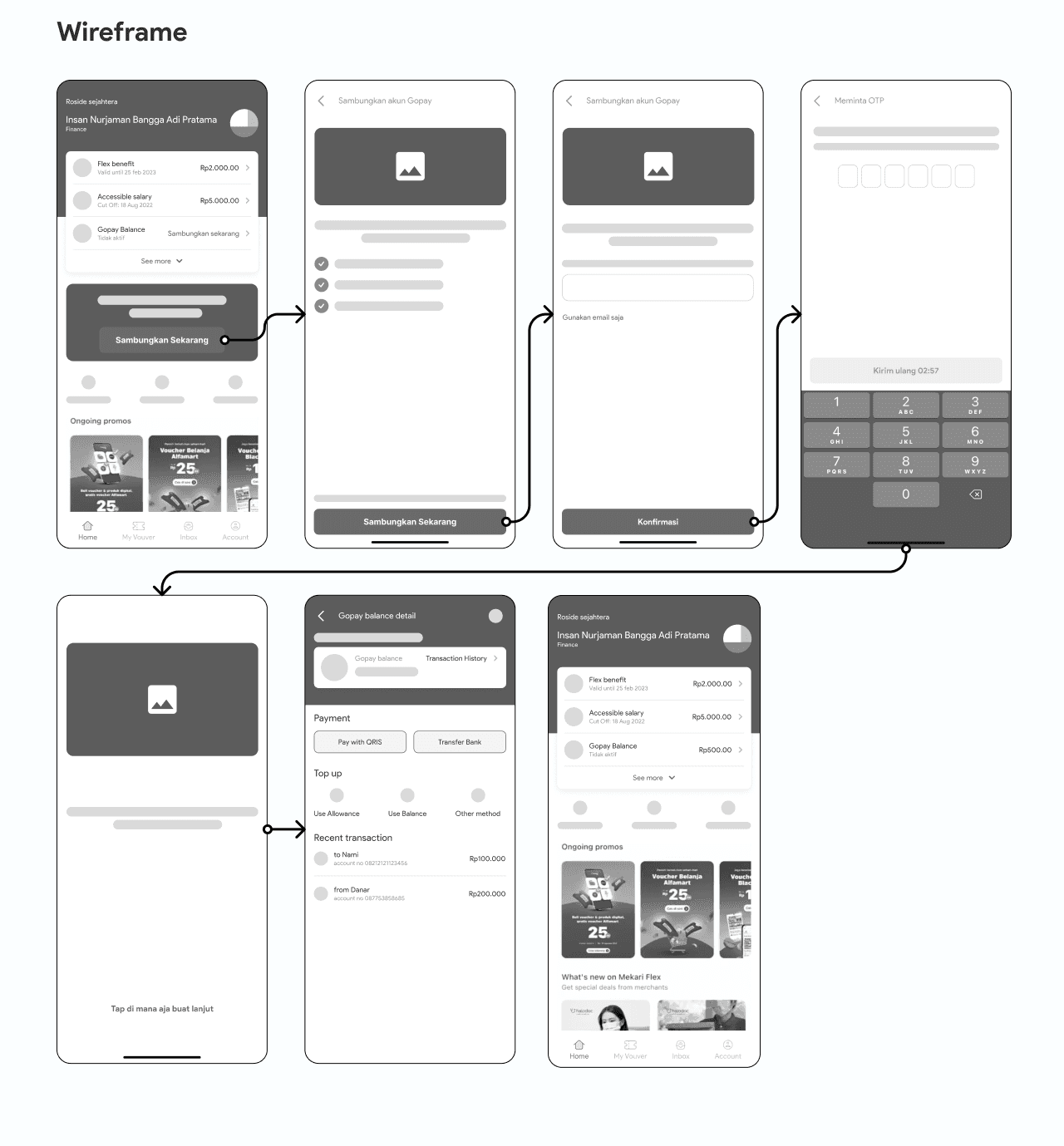 Low-fidelity connection wireframes. Original archive, panel 11; open at full size to inspect.
Key Decisions
Adding merchants individually and connecting to a broader payment destination are different approaches. The proposal explores the latter, but allowance policy, partner permissions, account ownership, financial compliance, and backend feasibility would need agreement before implementation.
Final Solution
The high-fidelity proposal includes a connection entry, benefit explanation, phone number and OTP steps, a success state, and GoPay balance and payment destinations. Example balances are interface content, not evidence of real transfers.
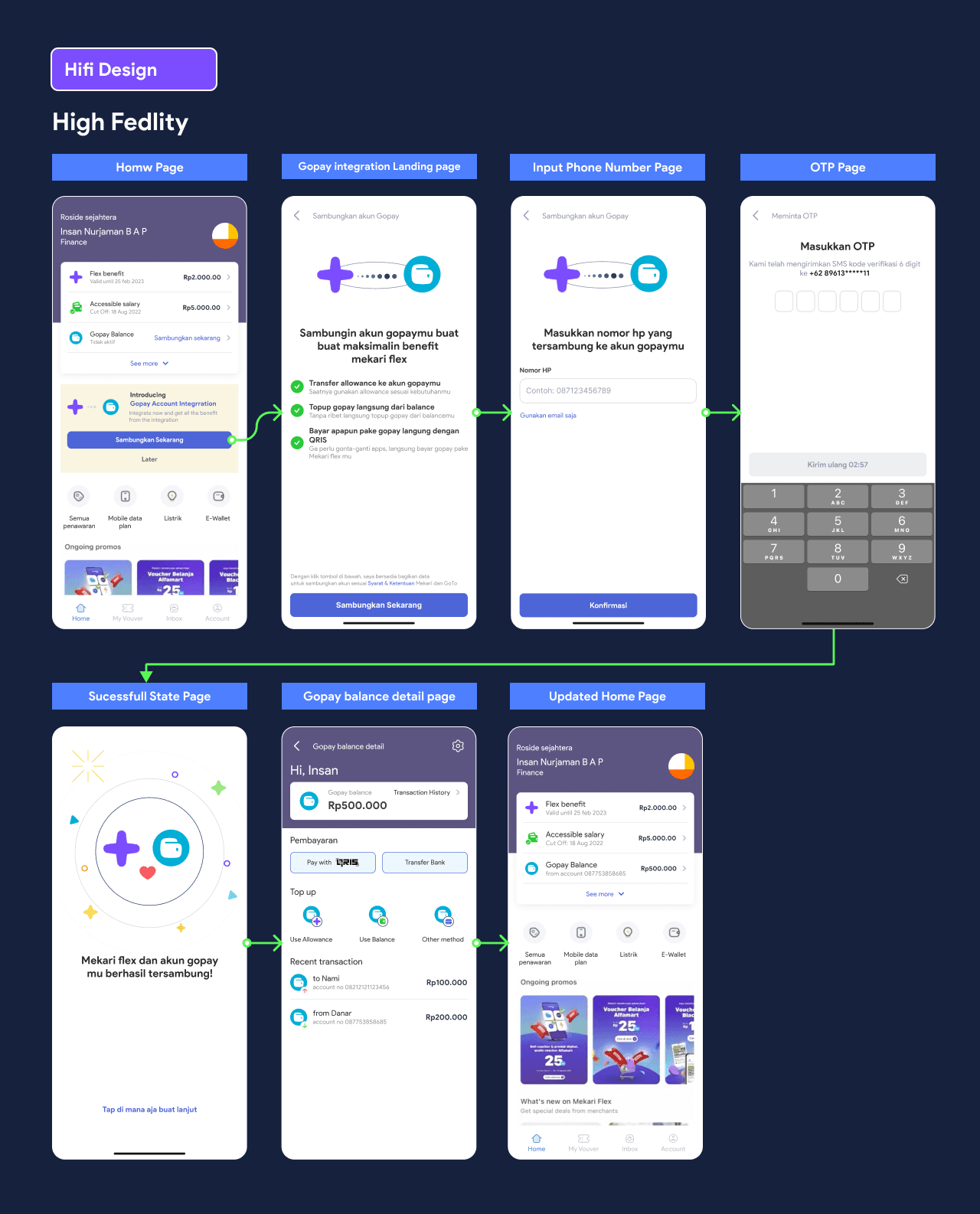 High-fidelity account-connection journey. Original archive, panel 12; open at full size to inspect.
 Additional interface design detail. Original archive, panel 13; open at full size to inspect.
 Additional interface design detail. Original archive, panel 14; open at full size to inspect.
 Mekari Flex and GoPay concept overview. Original archive, panel 15; open at full size to inspect.
Outcomes
The outcome is a researched integration proposal and connected mobile design. Allowance utilization, connection completion, production release, and commercial feasibility have not been established.
Evidence & limitations
This is a documented design proposal, not a claim of employment at Mekari, a commercial GoPay partnership, or a launched financial integration.
Survey demand does not establish that allowance rules or a payment partner permit the proposed behavior.
Learnings
- What worked in the design
- The proposal connects the integration to concrete spending needs rather than treating partnership visibility as the goal.
- What I would change next
- Validate policy and technical feasibility first, then test account ownership, failed verification, allowance allocation, and connection comprehension before measuring utilization.
 Original project closing. Original archive, panel 16; open at full size to inspect.

