Overview
- The problem
- Renters struggle to find reliable product information, while owners worry about verification, damage, and loss.
- My contribution
- I documented rental research, problem synthesis, a storyboard, the rental flow, and a mobile interface concept.
- The outcome
- A concept connecting discovery and product detail to rental duration, agreement, payment, and tracking.
Problem
Archived survey charts and open responses cover renting and listing behavior. The synthesis highlights missing product detail, difficulty finding items, mismatch, verification and collateral effort, and fear of loss. These are research findings in the design archive, not marketplace performance data.
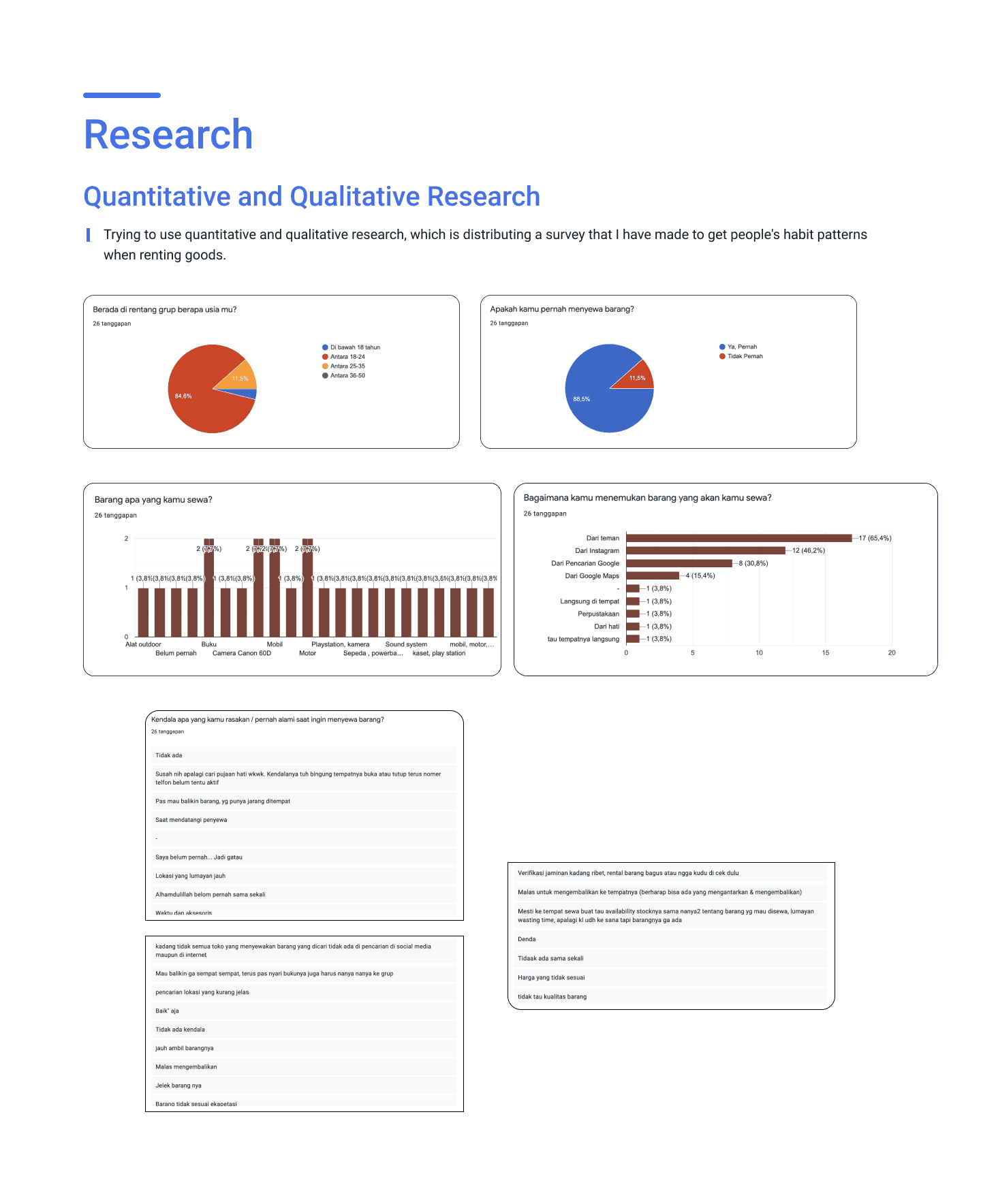 Rental-behavior survey charts and responses. Original archive, panel 4; open at full size to inspect.
 Owner listing, collateral, and safety survey responses. Original archive, panel 5; open at full size to inspect.
 Rental problem synthesis. Original archive, panel 6; open at full size to inspect.
My Role
- Company / product context
- Relling · Rental-marketplace design exploration
- Users
- People renting products and people listing products for rent.
- My role & scope
- I documented rental research, problem synthesis, a storyboard, the rental flow, and a mobile interface concept.
- Evidence available
- Original project narrative and design artifacts retained in this case study.
 Rental-marketplace concept overview. Original archive, panel 2; open at full size to inspect.
Process
A rental storyboard and user flow connect discovery to checkout, duration, delivery information, an agreement, payment, and tracking. The record illustrates the intended sequence; it does not publish a comparative usability study.
 Research-to-design approach. Original archive, panel 3; open at full size to inspect.
 Rental storyboard. Original archive, panel 8; open at full size to inspect.
 Discovery-to-payment rental user flow. Original archive, panel 9; open at full size to inspect.
Key Decisions
Removing every verification step could reduce friction while undermining trust. The concept uses product detail, an agreement, and a digital-signature step, but the balance between assurance, privacy, and effort requires validation. A signature screen cannot itself guarantee the safety of goods.
 Product-information, assurance, and rental design goals. Original archive, panel 7; open at full size to inspect.
Final Solution
The final mobile concept covers onboarding, browse and search, product details, chat, rental configuration, agreement and signature, payment, and delivery tracking. Original screens preserve the surrounding interaction context.
 High-fidelity rental interface overview. Original archive, panel 10; open at full size to inspect.
Outcomes
The deliverable is the rental concept and its research/flow artifacts. Launch, successful rentals, fraud reduction, loss prevention, and conversion improvement are not established.
Evidence & limitations
The archive's Privy integration and safety language describes the proposal. It is not evidence of an implemented identity integration or a security guarantee.
The design cannot establish that verification prevents loss or that the agreement is usable and enforceable.
Learnings
- What worked in the design
- Trust concerns appear in the rental journey rather than only in marketing language.
- What I would change next
- Test both renter and owner tasks, evaluate comprehension and abandonment around verification, and review privacy and operational responsibilities with appropriate specialists.
 Original project closing. Original archive, panel 11; open at full size to inspect.

